
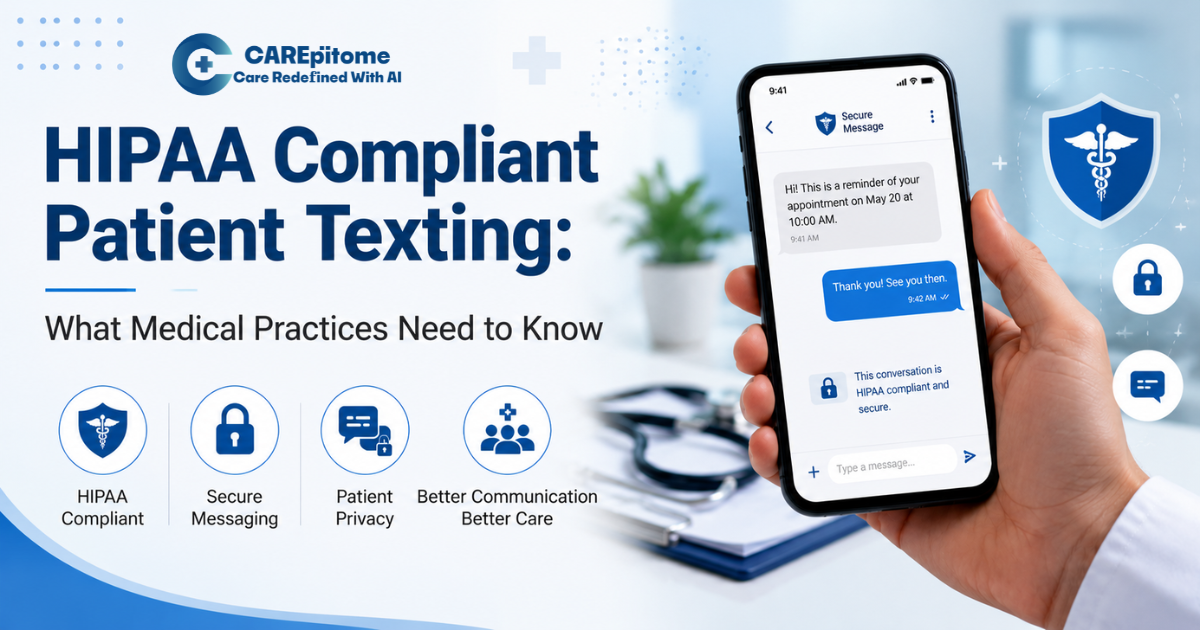
Text messaging is how patients want to hear from their doctor — but one unsecured message containing health information can turn into a HIPAA violation, a breach report, and a fine. The good news: texting patients is completely allowed under HIPAA when you do it the right way. This guide breaks down the HIPAA texting rules for clinics, what makes HIPAA compliant patient texting actually compliant, and how to roll it out at your practice without adding risk.
Is Texting Patients HIPAA Compliant?
Yes - texting patients is HIPAA compliant when PHI is protected by the right safeguards. HIPAA does not ban text messaging. In fact, the HIPAA Privacy Rule permits — and when a patient requests it, requires — covered entities to communicate with patients by text, as long as reasonable safeguards are applied (45 CFR § 164.522(b)).
The problem isn't texting itself — it's the channel. Standard SMS and consumer apps like iMessage and WhatsApp send messages in plain text and offer no encryption, access controls, or audit trails. That means they can't satisfy the HIPAA Security Rule when the message contains PHI. So the real question isn't “is texting patients HIPAA compliant?” - it's “am I texting through a compliant platform?”
What Makes Patient Texting HIPAA Compliant?
Patient texting becomes HIPAA compliant when six safeguards are in place: encryption, access controls, audit trails, a signed BAA, documented consent, and the minimum-necessary standard. Miss any one of these and you introduce compliance risk.
- Encryption. PHI must be encrypted in transit and at rest so an intercepted message is unreadable to anyone but the intended recipient.
- Access controls & authentication. Unique user logins, role-based permissions, and ideally multi-factor authentication ensure only authorized staff can view messages.
- Audit trails. The platform must log who sent and received each message, with timestamps, and keep those logs available for audits or investigations.
- Business Associate Agreement (BAA). Any vendor that transmits or stores PHI on your behalf is a business associate and must sign a BAA. Without one, using the service for PHI is a violation.
- Patient consent. Obtain and document the patient's opt-in to receive texts, along with an acknowledgment of the risks of electronic communication.
- Minimum necessary. Send only the information needed for the purpose — an appointment time and location, not a full diagnosis.
A purpose-built patient communication software HIPAA-ready platform bundles all six into one system, so your team isn't manually policing every message.
HIPAA Texting Rules for Clinics: Patient-Initiated vs. Practice-Initiated
HIPAA treats a text the patient starts differently from a text your practice starts. Understanding both scenarios keeps your clinic on the right side of the rules.
When the patient texts first
If a patient initiates contact by text or explicitly requests to communicate this way, your practice may respond with PHI — but you should warn them that ordinary text isn't secure, honor their preference, and document that conversation and consent. HIPAA lets patients accept the risks of a less-secure channel once they've been informed.
When your practice texts first
Outbound messages your practice sends — appointment reminders, recalls, forms, results notifications — should go through a secure patient messaging platform. This is the safest default and the only reliable way to meet the Security Rule's requirements for secure SMS for healthcare providers at scale.
How to Set Up HIPAA Compliant Patient Texting (Step by Step)
You can launch compliant texting in five steps. Follow this sequence and you'll have a defensible, audit-ready program.
- Choose a secure platform and sign a BAA. Select patient communication software built for HIPAA and get the Business Associate Agreement signed before any PHI moves.
- Run a HIPAA risk assessment. Document how PHI flows through texting and identify safeguards for devices, apps, and staff access.
- Collect and log patient consent. Capture opt-in at intake or via a reply keyword, and store it with a risk acknowledgment.
- Write a texting policy and train staff. Define who can text PHI, what content is allowed, and the minimum-necessary rule. Train the whole team.
- Enable two-way messaging and monitor. Turn on two way patient text messaging so patients can confirm, reschedule, and ask questions — then review audit logs regularly.
The Benefits of Two-Way Patient Text Messaging
Compliant texting isn't just about avoiding fines — it drives real results. Practices that adopt two way patient text messaging typically see measurable improvements across the board.
- Fewer no-shows. Automated reminders with text confirmations can cut no-show rates dramatically, protecting revenue and schedule density.
- Less phone tag. Patients reply on their own time instead of sitting on hold, freeing front-desk staff for higher-value work.
- Faster scheduling. Patients confirm, cancel, or reschedule straight from the reminder, keeping your calendar full.
- Higher satisfaction and loyalty. Convenient, modern communication is now something patients expect — and switch providers to get.
How to Choose a Secure Patient Messaging Platform
Choose patient communication software HIPAA-ready from the ground up — not a consumer app with a compliance sticker. Use this checklist when you evaluate vendors:
- Signed BAA provided as standard.
- End-to-end encryption for data in transit and at rest.
- Access controls with unique logins, roles, and MFA.
- Complete audit trails that are exportable for investigations.
- Two-way messaging plus automated reminders, recalls, and forms.
- EHR / practice-management integration so data flows without duplicate entry.
- No-app-download experience so patients can respond without friction.
CAREpitome checks every box — combining HIPAA compliant patient texting, automated reminders, a secure patient portal, digital forms, telemedicine, and AI-assisted scheduling in one platform built for medical and dental practices.
Common HIPAA Texting Mistakes to Avoid
Most texting violations come from a handful of avoidable errors. Watch for these:
- Using personal phones or consumer apps (iMessage, WhatsApp) to send PHI.
- Texting PHI without a signed BAA with the vendor.
- Skipping documented consent or ignoring a patient's revoked preference.
- Oversharing clinical detail when a time and location would do (minimum necessary).
- No audit logs or retention policy, leaving you unable to prove compliance.
How CAREpitome Delivers HIPAA Compliant Patient Texting
CAREpitome gives medical and dental practices secure patient texting inside one AI-powered patient engagement platform — so you get compliant messaging plus the reminders, forms, and scheduling that surround it, without stitching together separate tools.
On the compliance side, CAREpitome is built with a HIPAA-aligned approach: patient data is encrypted in transit and at rest, access is role-controlled, every action is audit-logged, and CAREpitome signs a Business Associate Agreement (BAA) with every practice. The platform is also SOC 2 aligned with FHIR/HL7 EHR integration.
Here's how the pieces map to the safeguards covered above:
- Patient Communication (Conversation) — AI-powered, multi-channel, two way patient text messaging that lets patients reply, confirm, and ask questions on a secure platform.
- Appointment Reminders — automated SMS and email reminders that cut no-shows and let patients confirm or reschedule by reply.
- Patient Portal — secure patient access to records and messaging for anything that shouldn't go over plain SMS.
- Digital Forms — collect intake and consent electronically, including opt-in for text communication.
- Security & Compliance — encryption, granular access controls, and audit trails underpinning every message.
Because it's one connected system, a patient's reminder, reply, form, and record all stay in sync with your EHR — no duplicate entry, and no PHI slipping into an unsecured personal-phone thread.