
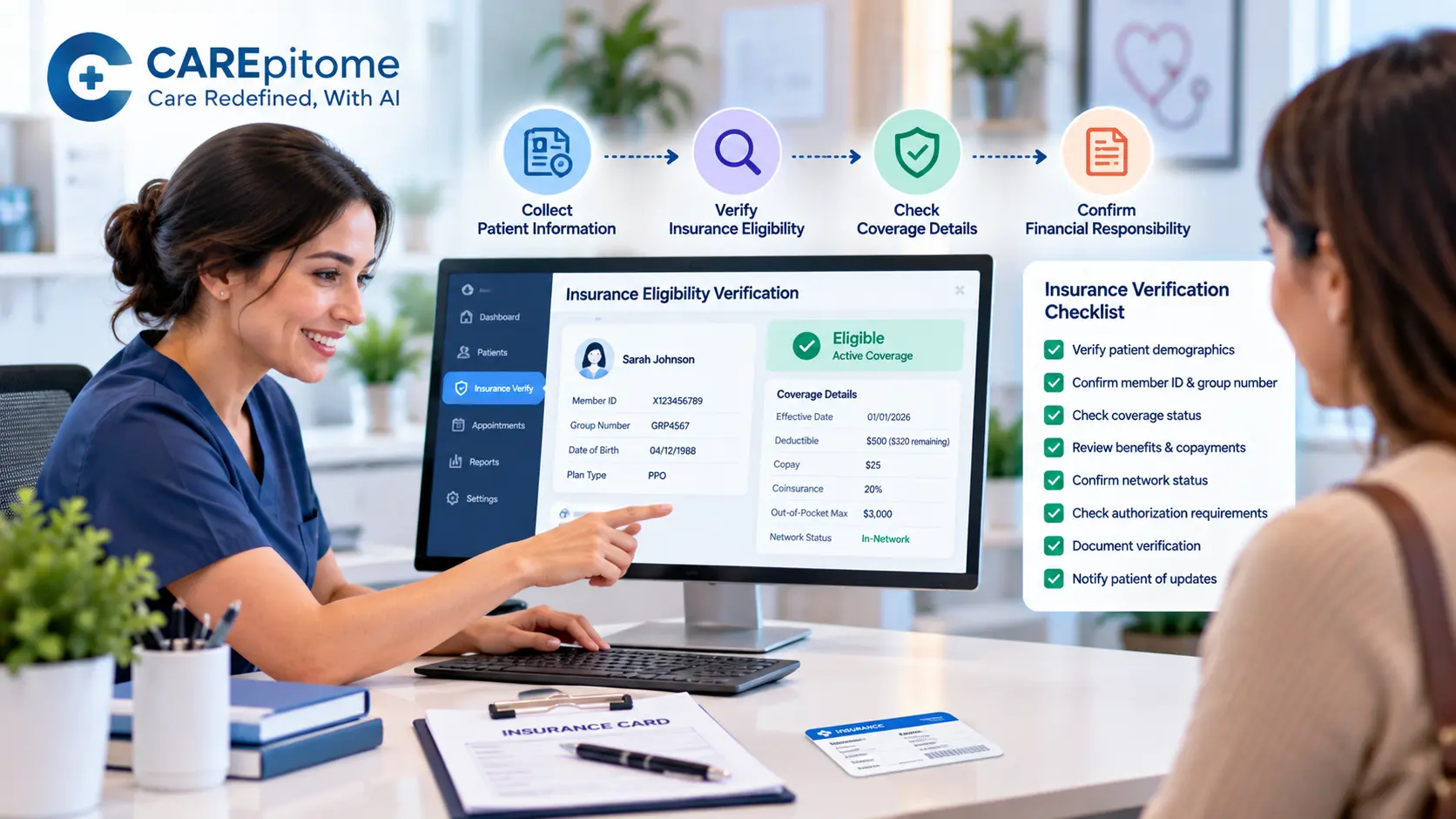
The insurance eligibility verification process is a critical part of the healthcare revenue cycle. Before a patient receives services, a medical practice needs to know whether the patient's insurance is active, what services may be covered, and what financial responsibilities may apply.
When eligibility is not verified correctly, practices can face unexpected patient balances, claim rejections, delayed payments, and additional administrative work. A structured verification workflow helps front-desk and billing teams identify insurance issues before they become costly problems.
Modern healthcare technology can also make verification faster and more consistent. Solutions such as CarePITome can help practices move repetitive administrative workflows toward more connected digital processes.
What Is the Insurance Eligibility Verification Process?
The insurance eligibility verification process involves checking a patient's insurance coverage before a scheduled healthcare service.
The purpose is to confirm that the patient's coverage is active and determine relevant benefit information for the planned service. Depending on the payer and transaction, verification may provide information about deductibles, copayments, coinsurance, coverage limitations, and network status.
Electronic eligibility and benefit verification commonly uses the HIPAA-adopted ASC X12N 270/271 transaction. The 270 is the eligibility inquiry and the 271 is the corresponding response. CMS identifies these transactions as the standard electronic method for obtaining health plan eligibility and benefit information.
Verification should therefore be treated as more than simply checking whether an insurance card exists. The goal is to determine whether the coverage information is usable and relevant to the upcoming appointment.
Why Insurance Verification Matters
Insurance information can change frequently. A patient may have a new employer, a different insurance plan, an updated member ID, changed benefits, or a policy that is no longer active.
Assuming that information from a previous visit is still accurate can create problems.
Accurate verification helps practices identify issues before the patient receives care. It can also give staff an opportunity to contact the patient about missing or incorrect information.
This can support a more predictable billing process and reduce avoidable administrative follow-up.
Step 1: Collect Accurate Patient Insurance Information
The verification process begins with reliable patient data.
The practice should collect the relevant information from the patient's insurance card or digital insurance information. Depending on the payer and workflow, this may include:
- Patient name
- Date of birth
- Member ID
- Group number
- Subscriber information
- Payer name
- Policy information
- Relationship to subscriber
- Provider or plan information
Even a small data-entry error can cause an eligibility inquiry to fail or return information that does not match the patient's records.
Digital registration and connected intake workflows can help reduce repetitive manual entry before verification begins.
Step 2: Submit an Eligibility Inquiry
Once the patient information is available, the practice submits an eligibility request to the payer or an appropriate clearinghouse or eligibility system.
The electronic 270/271 workflow is specifically designed for this exchange. CMS explains that health plans respond to provider eligibility questions with information about coverage and financial responsibility, including items such as deductibles, copayments, coinsurance, and service-specific coverage.
For Medicare, CMS's HETS 270/271 system supports real-time eligibility requests and responses for authorized users.
Step 3: Perform a Real-Time Eligibility Check
A real-time eligibility check can provide current information close to the time the request is submitted.
Real-time access is particularly useful because insurance information may change between appointments. CMS notes that federal eligibility operating rules require applicable health plans to respond in real time to provider eligibility questions with financial and coverage information.
However, a real-time response should still be interpreted carefully. The result reflects the information returned by the payer and does not necessarily guarantee payment for a specific service.
Staff should review the information in the context of the scheduled visit and applicable payer requirements.
Step 4: Review Benefits and Patient Responsibility
Eligibility verification should go beyond determining whether a policy is active.
The response may provide information about:
- Deductible amounts
- Copayments
- Coinsurance
- In-network or out-of-network coverage
- Covered services
- Benefit limitations
- Service-specific eligibility information
This information can help practices communicate expected financial responsibility to patients more accurately.
It is important to distinguish eligibility from a guarantee of payment. Verification confirms information reported by the payer; it does not eliminate the possibility of claim-specific processing rules or later adjudication decisions.
Step 5: Compare the Information With the Scheduled Service
The next step is to determine whether the verified benefits are relevant to the planned appointment.
For example, a patient's plan may be active but have different coverage rules for specific services, specialists, facilities, or network levels.
The front desk or billing team should therefore compare the patient's coverage information with the type of service being scheduled.
This step is especially important for practices that provide services with different coverage or authorization requirements.
Step 6: Document the Verification
Documentation creates a record of what was checked and when it was checked.
The practice should record the verification date, payer response, relevant benefit details, and any follow-up actions required.
A documented workflow makes it easier for staff to understand what happened when an eligibility problem appears later.
It can also reduce the need to repeat the same investigation when multiple staff members are involved in scheduling, registration, and billing.
Insurance Verification Checklist for Front Desk
An insurance verification checklist for front desk staff can standardize the process and reduce missed steps.
A practical checklist may include:
- Confirm the patient's demographic information.
- Verify the payer and member ID.
- Confirm subscriber information.
- Check whether coverage is active.
- Review deductible, copay, and coinsurance information.
- Check relevant network information.
- Review coverage for the scheduled service.
- Identify authorization or referral requirements when applicable.
- Document the eligibility response.
- Contact the patient when information is missing or financial responsibility needs clarification.
A standardized checklist can help make verification more consistent across staff members and appointments.
How to Reduce Claim Denials From Eligibility Errors
One major objective of verification is to reduce claim denials from eligibility errors.
Eligibility-related problems can occur when coverage is inactive, patient information does not match payer records, an incorrect member ID is submitted, or the service is not covered under the patient's plan.
Verification performed early in the workflow gives practices an opportunity to identify these issues before claims are submitted.
However, eligibility verification should be part of a broader revenue-cycle process. Accurate coding, authorization management, documentation, claim submission, and payer-specific requirements still affect claim outcomes.
The goal is not to eliminate every denial but to catch preventable eligibility problems before they reach the claims stage.
Manual vs. Automated Insurance Verification
Manual verification can involve logging into payer portals, calling insurers, recording information, and moving data between multiple systems.
For a small number of patients, this may be manageable. As patient volume increases, however, repetitive manual verification can consume substantial staff time.
Automated insurance verification software can help streamline parts of this process by sending eligibility requests, retrieving responses, organizing verification information, and incorporating results into a broader administrative workflow, depending on the platform.
Automation does not remove the need for staff oversight. Instead, it can reduce repetitive work and allow staff to focus on exceptions and cases requiring human review.
You can explore CarePITome's insurance verification software to see how technology can support a more organized eligibility workflow.
Best Practices for a More Efficient Verification Workflow
An effective process should be consistent, timely, and connected to scheduling and registration.
Practices should avoid relying exclusively on old insurance information, particularly when an appointment was scheduled far in advance. Verification should be performed according to the practice's workflow and payer requirements, with a process for handling changes before the visit.
It is also useful to create clear responsibility between scheduling, front-desk, billing, and eligibility teams. Everyone should understand which information they verify, what they document, and when an issue should be escalated.
Technology can support this coordination by reducing unnecessary manual handoffs.
For more information about CarePITome's healthcare technology approach, visit the About page.
Making Insurance Verification Part of a Connected Workflow
Eligibility verification is most effective when it is integrated into the broader patient and revenue-cycle journey.
A connected workflow can move from appointment scheduling to registration, insurance verification, patient communication, service delivery, and billing without requiring staff to repeatedly enter the same information.
This can make it easier to identify errors earlier and create a more predictable administrative process.
Practices interested in healthcare automation can also explore the CarePITome blog for additional information about digital healthcare workflows and practice management technology.
To discuss how insurance verification technology could fit into a practice's workflow, schedule a demo.