
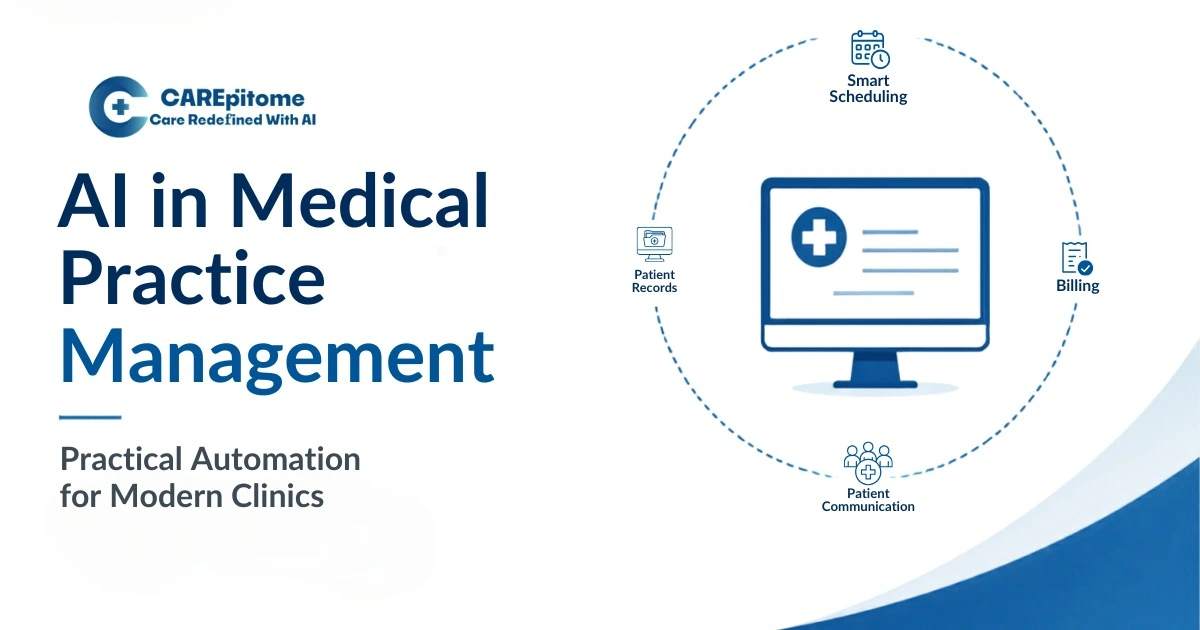
Quick Answer: How Does AI Help Medical Practice Management?
AI in medical practice management helps clinics reduce repetitive administrative work by automating tasks such as appointment scheduling, reminders, patient intake, documentation, communication, data processing, and workflow coordination. The practical value is not replacing clinicians or staff. It is giving them more time for patients and higher-value work.
The best approach is to use AI where workflows are repetitive, measurable, and suitable for human review while maintaining appropriate privacy, security, oversight, and quality controls.
AI in Medical Practice Management: Practical Automation for Modern Clinics
Running a modern medical practice involves much more than providing clinical care. Front-desk teams coordinate appointments, answer patient messages, process forms, update records, verify information, and keep schedules moving. Providers can also spend significant time documenting encounters and navigating electronic health records.
When these processes depend heavily on manual data entry and repetitive communication, a busy practice can lose valuable hours every week.
This is where AI in medical practice management can make a practical difference.
AI is most useful when it works as an operational layer around the care team. Instead of asking artificial intelligence to make clinical decisions independently, clinics can use it to organize information, draft routine content, identify workflow steps, automate predictable actions, and help staff find information faster.
The goal is simple: identify repetitive work, automate the appropriate parts, keep people in control, and measure whether the change actually improves the workflow.
What Is AI in Medical Practice Management?
AI in medical practice management refers to the use of artificial intelligence and automation technologies to support administrative, operational, documentation, and patient-engagement processes within a healthcare practice.
Common examples include:
- Appointment scheduling and reminders
- Digital patient registration and intake
- AI-assisted clinical documentation
- Patient communication
- Information retrieval and chart summaries
- EHR data synchronization
- Workflow automation
- Operational analytics
This is broader than simply adding an AI chatbot to a medical website.
For example, an AI tool that creates a draft clinical note can save documentation time. However, the workflow becomes more valuable when the provider can review and approve the note and transfer it into the appropriate EHR workflow without unnecessary copy-and-paste.
That distinction matters when evaluating medical practice automation tools.
6 Practical Ways AI Can Save Clinics Time and Money
1. Automate Appointment Scheduling and Reminders
Scheduling is one of the most repetitive processes in a medical office. Staff may spend considerable time answering calls, checking provider availability, moving appointments, and reminding patients about upcoming visits.
AI-enabled scheduling can help automate predictable parts of this process.
Smart scheduling systems can coordinate availability, support online appointment requests, send reminders, update appointment statuses, and help staff manage multiple providers or locations.
The benefit is not simply fewer phone calls. A connected scheduling workflow can reduce administrative friction and allow staff to focus on exceptions and patients who need personal assistance.
CAREpitome provides smart scheduling, calendar synchronization, automated reminders, and appointment-management capabilities as part of its broader healthcare platform.
Explore CAREpitome's patient engagement and practice-management platform
2. Reduce Documentation Burden With AI Scribing
Documentation is another area where automation can create an immediate operational benefit.
AI medical scribes can capture a clinician-patient conversation and generate a structured draft note for review. Instead of spending additional time typing every detail after an appointment, the provider can review, correct, and approve an AI-generated draft.
The important point is that AI-generated documentation should support clinical professionals rather than replace clinical judgment.
CAREpitome Scribe is designed around this workflow. It supports recording through mobile, browser, and Chrome extension experiences, generates structured notes, allows providers to edit and approve them, and supports EHR workflows.
Learn more about CAREpitome Scribe
This is a practical example of medical practice automation tools reducing repetitive work while keeping the clinician involved in the final documentation process.
3. Make Patient Communication More Efficient
Patients increasingly expect convenient and responsive communication. At the same time, answering every routine question manually can place additional pressure on front-desk and administrative teams.
AI patient engagement software can automate appropriate communications such as appointment reminders, registration instructions, follow-up messages, and other routine interactions.
The best systems should also provide escalation paths when a patient needs human assistance.
CAREpitome combines patient communication, automated responses, scheduling, telemedicine, and other patient-engagement capabilities in one platform.
Explore CAREpitome's patient engagement capabilities
Automation should not make healthcare feel impersonal. The objective is to automate predictable communication while preserving human interaction when empathy, context, or professional judgment is required.
4. Help Staff Find Patient Information Faster
Healthcare professionals and administrative teams can spend significant time reviewing records before appointments.
AI can reduce information-retrieval work by organizing information into concise summaries and allowing users to ask questions using natural language.
CAREpitome's Ask AI capability is designed to provide chart-grounded answers, narrative summaries, problem-oriented information, and encounter timelines from connected patient records.
This type of artificial intelligence for clinics can help teams understand relevant patient information without manually searching through multiple sections of a record.
However, AI summaries should remain a workflow aid. Users should be able to review the underlying record whenever accuracy, context, or clinical judgment is important.
5. Reduce Duplicate Data Entry With EHR Integration
Automation becomes less useful when staff still have to copy information from one system into another.
EHR integration is therefore an important part of any healthcare automation strategy.
Connected systems can help move approved information between applications, reduce repeated data entry, and keep workflows synchronized.
CAREpitome describes its EHR integration capabilities as supporting HL7 and FHIR-based interoperability, including workflows that can transfer finalized AI-generated notes into connected EHR systems.
Learn about CAREpitome EHR integration
When evaluating healthcare workflow AI solutions, interoperability should be considered alongside the AI itself.
Ask:
- Does the system fit the existing workflow?
- Can information move between systems?
- Does it reduce duplicate data entry?
- Where is human approval required?
- Can staff easily identify and correct errors?
6. Use Analytics to Identify Operational Bottlenecks
Not every workflow problem is obvious.
A practice may know that staff are overloaded without knowing exactly which process consumes the most time.
Analytics can help practices identify patterns involving scheduling, patient communication, workflow completion, patient activity, and other operational processes.
Once a bottleneck is measurable, practice managers can determine whether automation is appropriate.
The key is to measure outcomes rather than simply counting automated actions.
Useful metrics can include:
- Administrative time per appointment
- Patient response time
- Scheduling completion rate
- Documentation turnaround time
- Number of manual workflow steps
- Staff time spent on repetitive tasks
AI for Healthcare Administration: Where Should a Clinic Start?
Clinics do not need to automate everything at once.
A practical implementation can begin with one high-volume, repetitive workflow.
Step 1: Map the workflow
Document the current process from beginning to end, including handoffs, duplicate data entry, and manual approvals.
Step 2: Identify friction
Look for tasks that are repetitive, rules-based, time-consuming, or prone to avoidable delays.
Step 3: Choose a suitable starting point
Scheduling, reminders, digital intake, documentation drafts, and information retrieval can be potential starting points depending on the practice.
Step 4: Define human review
Decide which actions AI can perform automatically and which require staff or clinician approval.
Step 5: Establish a baseline
Measure the current process before introducing automation.
Step 6: Measure the result
Compare time, turnaround, accuracy, staff workload, or other relevant metrics after implementation.
This approach is more sustainable than selecting an AI platform simply because it has the largest feature list.
What Should Clinics Look for in Medical Practice Automation Tools?
Healthcare organizations should evaluate AI based on workflow fit rather than marketing claims alone.
Important considerations include:
Security and privacy
Understand how protected health information is handled, stored, transmitted, and accessed.
Human oversight
Users should be able to review and correct AI-generated outputs before consequential actions are taken.
Transparency
Organizations should understand the intended use, limitations, and appropriate workflow for the AI capability.
EHR interoperability
Determine whether the platform works with existing healthcare technology and reduces duplicate data entry.
Auditability
Appropriate logs and controls can help organizations understand what happened within an automated workflow.
Scalability
Consider whether the system can support additional providers, locations, or workflows as the practice grows.
Measurable ROI
Establish practical metrics before implementation so the clinic can determine whether automation is delivering value.
The FDA's guidance on AI-enabled medical technologies emphasizes areas such as intended use, transparency, performance, benefits, risks, limitations, human-centered design, and ongoing monitoring. These principles reinforce an important lesson for healthcare organizations: AI should fit the workflow and the people using it rather than operate as a black box disconnected from healthcare operations.
Can AI Replace Medical Office Staff?
For most practical practice-management applications, the stronger business case is augmentation rather than replacement.
AI can handle repetitive work, while healthcare professionals and administrative staff continue to provide context, judgment, empathy, exception handling, and accountability.
For example, a scheduling system may automatically send appointment reminders while staff handle unusual scheduling requests.
An AI scribe may create a documentation draft while the clinician verifies and approves it.
A patient communication system may respond to routine questions while escalating complex issues to a member of the team.
This human-in-the-loop approach can make automation more useful because technology handles predictable tasks while people remain responsible for decisions requiring judgment.
A Practical Example of AI in Medical Practice Management
Consider a typical patient journey.
A patient requests an appointment online. The scheduling system identifies an available slot and sends confirmation and reminders.
Before the visit, digital intake information is collected and organized.
During the appointment, an AI scribe generates a draft clinical note.
The clinician reviews and approves the documentation.
The finalized note is transferred into the connected EHR workflow.
After the visit, the patient receives an appropriate follow-up communication.
Each automation may appear small individually. Together, they can eliminate several manual handoffs from the same patient journey.
That is the real opportunity behind AI in medical practice management: not one dramatic automation, but a connected workflow that quietly removes unnecessary administrative steps.
Responsible AI Matters in Healthcare
Healthcare is a high-trust environment.
AI systems can produce inaccurate outputs, miss context, or perform differently across use cases and patient populations. That makes governance and human oversight important.
Practices should establish approved use cases, train staff, define review requirements, protect sensitive information, and monitor performance over time.
The FDA emphasizes transparency and human-centered considerations for AI-enabled medical technologies, including communicating relevant information about intended use, performance, benefits, risks, limitations, and workflow impact.
For healthcare organizations, responsible AI is not simply a compliance issue. It is also an adoption issue.
Staff are more likely to trust automation when they understand what the technology does, what it does not do, and when they remain able to review its output.
The Future of AI-Powered Clinic Operations
AI will likely become less visible as it becomes more deeply integrated into everyday healthcare workflows.
Instead of staff opening a separate AI application for every task, intelligent capabilities can increasingly appear within scheduling, documentation, communication, analytics, patient management, and EHR workflows.
For modern clinics, the competitive advantage will not necessarily come from using the largest number of AI features.
It will come from choosing the right workflows, implementing automation responsibly, integrating systems effectively, and measuring results continuously.
AI in medical practice management is most valuable when it gives healthcare professionals something they cannot easily create more of: time.
By automating repetitive administrative work while keeping people in control, clinics can create more efficient operations without making healthcare less human.